In the previous post we wrote about the Mongolian ice sculptors competing at Korkeasaari Zoo in the Helsinki archipelago. The winner of the individual competition was announced today, and he is also Mongolian! Lkhagvadorj Dorjsuren won the first prize with his intricately carved work "The Lunch", depicting the competition's maritime and environmentally conscious theme through the shape of a seagull eating garbage - a prosaic subject rendered alarmingly beautiful and calling our attention to the effects of pollution. The jury especially praised the shapes of the waves at the base of the sculpture. The competition will continue next weekend, 9.-10.2.2013.
More photos and video clips: Korkeasaari Zoo media gallery
Showing posts with label Mongolia. Show all posts
Monday, 4 February 2013
Sunday, 3 February 2013
Mongolian Ice Sculptors in Finland
The Korkeasaari Zoo in Helsinki, located on an island within the city archipelago, currently celebrates an international ice sculpting festival, Art Meets Ice 2013. Many of the participants are from Mongolia. Above, Bazarsad Bayarsaikhan and Dorjnamil Baatar work on their individual projects in the "Life on the Baltic Sea" competition, and they will also compete against each other and the other participants in teams of two in the tandem competition "My Sea". There's a promotional video on the Korkeasaari Zoo's website.
It will be exciting to see what maritime subjects the Mongolian artists will tackle. As a serendipitous coincidence, a Przewalski's horse at the zoo has foaled during their visit. Przewalski's horse (or Dzungarian horse) is an endangered subspecies of wild horse from the Central Asian steppes. Once it was extinct in Mongolia, but it has been reintroduced into nature reserves in the country. It is considered the last truly wild horse, others (like the Mustangs of North America) being feral varieties of the domesticated horse.
Perhaps the birth of the foal, so laden with symbolism, will inspire the artists even more in this competition? According to the Finnish national broadcasting service YLE, the artists were delighted by the news, and believe that it's a filly, although the zoo has not published any details yet... (video of the furry little foal here) (news in Finnish)
Photo source: Korkeasaari Zoo media gallery
Monday, 11 July 2011
National Day of Mongolia
Today, Mongolia celebrates its 90th national day.
On July 11, 1921, Mongolia was declared independent after the victories of a Mongol revolutionary army led by Damdin Sükhbaatar and supported by the Soviet Red Army. They defeated a White army led by Baron Ungern-Sternberg (with his own motives in conflict with other White Russian leaders - a fantastic story worth it's own post one day!) and the Chinese occupants of Outer Mongolia.
Sükhbaatar and Choibalsan, revolutionary leaders. Sükhbaatar was a popular military leader. He died less than a year after the declaration of independence, an event surrounded by rumours. Choibalsan went on to lead Stalin-style purges, first among the Mongol monarchists and Buddhist leaders, later within the Communist party itself.
But that was not the first or only occasion in the 20th century that Mongolia's independence was declared. In December 29, 1911, the Khalkhas of Outer Mongolia declared their independence from the Qing Dynasty. They installed a lama of a high lineage as the Bögd Khaan, and thus the first independent Mongolian state of the 20th century became a theocracy. This state was later occupied by the newly established Republic of China. The second declaration of independence in 1921 led to the establishment of the Mongolian People's Republic under strong Soviet influence in 1924.
Squeezed in between two great powers, Mongolia has had a difficult task of balancing between outer pressure and inner power struggles. In 1990, a peaceful revolution led by young people and students eventually caused the single-party system to crumble. (Interestingly, even Wikipedia mentions the "thousand-year parliamentary tradition" of Mongolia!)
Protestors in Sükhbaatar square, among them Sanjaasürengiin Zorig, one of the student leaders, who became a notable progressive politician and was mysteriously murdered in 1998.
So much for the strange and violent 20th century! Now let's relax with Börte, a wonderful band that plays traditional instruments and invents new melodies on a grand scale, take us through some ancient elements of Mongolian history in this beautiful composition "Gobi".
On July 11, 1921, Mongolia was declared independent after the victories of a Mongol revolutionary army led by Damdin Sükhbaatar and supported by the Soviet Red Army. They defeated a White army led by Baron Ungern-Sternberg (with his own motives in conflict with other White Russian leaders - a fantastic story worth it's own post one day!) and the Chinese occupants of Outer Mongolia.
Sükhbaatar and Choibalsan, revolutionary leaders. Sükhbaatar was a popular military leader. He died less than a year after the declaration of independence, an event surrounded by rumours. Choibalsan went on to lead Stalin-style purges, first among the Mongol monarchists and Buddhist leaders, later within the Communist party itself.But that was not the first or only occasion in the 20th century that Mongolia's independence was declared. In December 29, 1911, the Khalkhas of Outer Mongolia declared their independence from the Qing Dynasty. They installed a lama of a high lineage as the Bögd Khaan, and thus the first independent Mongolian state of the 20th century became a theocracy. This state was later occupied by the newly established Republic of China. The second declaration of independence in 1921 led to the establishment of the Mongolian People's Republic under strong Soviet influence in 1924.
Squeezed in between two great powers, Mongolia has had a difficult task of balancing between outer pressure and inner power struggles. In 1990, a peaceful revolution led by young people and students eventually caused the single-party system to crumble. (Interestingly, even Wikipedia mentions the "thousand-year parliamentary tradition" of Mongolia!)
Protestors in Sükhbaatar square, among them Sanjaasürengiin Zorig, one of the student leaders, who became a notable progressive politician and was mysteriously murdered in 1998.So much for the strange and violent 20th century! Now let's relax with Börte, a wonderful band that plays traditional instruments and invents new melodies on a grand scale, take us through some ancient elements of Mongolian history in this beautiful composition "Gobi".
Labels:
activists,
Mongolia,
musicians,
soldiers,
throat-singing
Saturday, 12 September 2009
Real Men!

A Mongolian horseman, photographed by Oksana Kalyuzhnaya (source: photosight.ru) in the Khövsgöl province.

Another horseman, a herder photographed by "Gorynych - The Green Serpent" at photosight.ru.
Thursday, 16 July 2009
Guardians of the Tsam Dance

Tsam performers dressed as warriors pose for a photo. They serve as guardians of the sacrifial offerings at the Erlik Tsam from Urga. Erlik Nomun Khan is a deity with shamanic origins who is identified with Yamaraja, the Lord of Death, in Buddhism.
The Tsam dance is an important tradition of Buddhist worship in Mongolia. The first recorded Tsam dances were performed in Tibet over 1000 years ago. Buddhism was introduced to Mongolia through Tibet, and both belong to the Vajrayana branch of Buddhism, with heavy emphasis of monastic lineage and esoteric knowledge. The Tsam dance is not only an artistic performance; it is primarily a religious ritual and its purpose is to defeat the enemies of Dharma - that is, combat suffering, aggression and ignorance. Besides the secret tantric meaning, which is only revealed to the initiated (and thus outside our reach :-)), it serves an educational cause. In the Tsam dance, performers mask themselves as benevolent and wrathful deities. (As a Shingon - also a tantric school of Buddhism - priest once told me: "Unfortunately people do not only learn by kind words...") This way, the lay audience learns to know its protectors and teachers in the next life. In Buddhist imagery, a fearsome appearance - a skull face, animal fangs, blood-dripping claws - does not necessarily mean that the creature is evil. Even the most chilling masks represent important teachers and guardians of the doctrine.

The Shanak sorcerers are described as sorcerers of "black magic", but their purpose is to defeat the enemies of religion.
An intriguing aspect of the philosophy behind Tsam is that "Besides pleasing the external environment, the tsam performance also purifies internal environment or mental afflictions of all sentient beings including humans and to lead them to the Buddha's path." (Geshe Luvsangenden.Z)
Found at Face Music, Switzerland
Wednesday, 13 May 2009
Mongolian hip hop group Tatar
Tatar is one of, if not the most popular hip hop group in Mongolia. I've had this video with a sad gangster love story among my YouTube favourites for months, but didn't get around to posting it until now ...
Hip hop is pretty young in Mongolia - it started in the 1990's. Since then it has quickly grown into the mainstream. The local flavour of Mongolian hip hop may include folk music influences and tributes to mothers (even more so than in American hip hop). Mongolian hip hop groups address problems in their society, such as unemployment and alcoholism, but they also make songs about love. The latter might dismay hardcore hip hop purists, but it certainly gives the music a wider appeal.
There is a nice article about the Mongolian hip hop scene over at Hip Hop Linguistics.
Hip hop is pretty young in Mongolia - it started in the 1990's. Since then it has quickly grown into the mainstream. The local flavour of Mongolian hip hop may include folk music influences and tributes to mothers (even more so than in American hip hop). Mongolian hip hop groups address problems in their society, such as unemployment and alcoholism, but they also make songs about love. The latter might dismay hardcore hip hop purists, but it certainly gives the music a wider appeal.
There is a nice article about the Mongolian hip hop scene over at Hip Hop Linguistics.
Monday, 4 May 2009
Altyn Orda

Some of my favourite screenshots from Sergei Eisenstein's Alexander Nevsky. Ahistorically, but politically correctly in Stalin's days, Nevsky refuses an alliance with the Golden Horde in the movie. In reality, Alexander Nevsky ensured peaceful relations with the Mongols by enforcing tribute from the principalities to the Golden Horde and uniting the Russian principalities against Western invasions. He became the Grand Prince of Vladimir thanks to his friendship with Sartaq Khan. This connection inspired the controversial school of Russian historical philosophy known as "Eurasianism".
Labels:
actors,
CCCP,
cute hats,
Mongolia,
moustache fetish,
Russia,
stereotypes
Saturday, 28 March 2009
200 Portraits of Genghis Khan
A comprehensive and searchable collection of images, more or less heroic, chiefly from Mongolia, but also from China and Iran. Collected by a researcher at Juniper, a francophone database on Mongolian and Siberian studies. (Via)The featured portrait is painted by Mongolian artist Cerendoržyn Ölzbaatar, and obviously inspired by Jean Auguste Dominique Ingres' portrait of Napoleon.
Wednesday, 3 December 2008
Kublai Khan
A Mongolian rock ballad to the memory of emperor Kublai Khan, grandson of Genghis Khan. Would not be complete without a smoke machine, the morin khuur (the horsehead violin) and khöömii (overtone singing). I love Mongolia.
Sunday, 26 October 2008
Camel polo!
Winter is coming closer. Mongolia has very fierce winters, but they have fun games for the winter to warm you (and your camels) up ...
We have previously covered the sport Ulak tartysh, or "goat grabbing", which is the original form of polo. There is a newer Mongolian variation of polo - Camel polo, in Mongolian Тэмээн поло or Тэмээн бeмбeг (camel-ball). Basically it's polo on camels. The Mongolian Camel Polo Association developed this game in the early 2000's, not least with the aim to help protect the two-humped Bactrian camel, which is becoming very rare. Today only 1,4 million of the world's about 20 million camels are two-humped. The wild Bactrian camel is officially classified as critically endangered - there are only less than a thousand of them. The rest are domesticated, and are used for transportation, wool, milk and meat. And now, also polo!
Flickr user mongolbob are, as far as I can tell, a husband and wife who are English teachers far out in Western Mongolia. Their photos are really fascinating, and they have a few pictures of camel polo.

Camel polo team, originally uploaded by mongolbob

Champion camel herder, originally uploaded by mongolbob

What a handsome pair!, originally uploaded by mongolbob
Also check out SamboJambo's set of photos from a Camel polo game in Dalanzadgad - there are some very nice photos there.
The Siam polo news actually reported about that very game in Dalanzadgad (a bit below the middle of this page):
"The temperature was -18*C, and there was blowing snow and sand as the tournament opened. Over two days, 32 games (64 chukkas) were played on two adjoining sand fields for a spectacular show of Camel Polo. [...] You whip the camel to go very fast and call out the word "Chuu." There are 4 people on a team, and there are no fouls -- anything goes."

This photo is from e-mongol.com, who organise individual tailored trips to Mongolia. I'm sure they can arrange special Camel polo winter trips!
Finally, a photo from the Mongol News Group:, taken by T. Chimgee:

Chuuu!
We have previously covered the sport Ulak tartysh, or "goat grabbing", which is the original form of polo. There is a newer Mongolian variation of polo - Camel polo, in Mongolian Тэмээн поло or Тэмээн бeмбeг (camel-ball). Basically it's polo on camels. The Mongolian Camel Polo Association developed this game in the early 2000's, not least with the aim to help protect the two-humped Bactrian camel, which is becoming very rare. Today only 1,4 million of the world's about 20 million camels are two-humped. The wild Bactrian camel is officially classified as critically endangered - there are only less than a thousand of them. The rest are domesticated, and are used for transportation, wool, milk and meat. And now, also polo!
Flickr user mongolbob are, as far as I can tell, a husband and wife who are English teachers far out in Western Mongolia. Their photos are really fascinating, and they have a few pictures of camel polo.

Camel polo team, originally uploaded by mongolbob

Champion camel herder, originally uploaded by mongolbob

What a handsome pair!, originally uploaded by mongolbob
Also check out SamboJambo's set of photos from a Camel polo game in Dalanzadgad - there are some very nice photos there.
The Siam polo news actually reported about that very game in Dalanzadgad (a bit below the middle of this page):
"The temperature was -18*C, and there was blowing snow and sand as the tournament opened. Over two days, 32 games (64 chukkas) were played on two adjoining sand fields for a spectacular show of Camel Polo. [...] You whip the camel to go very fast and call out the word "Chuu." There are 4 people on a team, and there are no fouls -- anything goes."

This photo is from e-mongol.com, who organise individual tailored trips to Mongolia. I'm sure they can arrange special Camel polo winter trips!
Finally, a photo from the Mongol News Group:, taken by T. Chimgee:

Chuuu!
Tuesday, 30 September 2008
Hii-mori

All photos in this post are by me, taken at Otgontenger mountain, Mongolia, in the summer of 2006. Click to enlarge.
These monks, other guys, and horses are not really related to the following text ...
Looking through discussion forums in search of Chirayliq material, I came across a thread discussing sex in nomadic Central Asian cultures. It was mostly a guy from Ulan Bator, nicknamed Bor Chono, writing in that thread, and he had some fascinating things to say:
"Surely Nomadic ppl have many children but it doesn`t mean that they have sex a lot. ;)
I guess Europians think that Nomads(=men) are monsters of sex -I mean "nomadic" barbarian men love women a lot.-who doesn`t? ;D
I can claim that nomads never had problem with erection. (Mongol)Old ppl claim that men who rides a horse will never have thingy problems. They say shaking your balls up & down is good for your thingy health. Riding a horse naked will increase your 'Hii-mori'='spiritual horse' & it`s also helpful for women.
But presently Mongols became sedentary so they face problems which sedentary ppl faced long before. So it seems like Mongols have almost no traditional knowledge about how to make thingy-standing. Surely Buddist monks have medecine to help men(=knowledge comes from India, Tibet & China). ::)
btw I don`t have such problems! ;D
...
Hii-mori is not a god to worship. Hii-mori is one of your Spirits -That`s inside U. It`s something like Men`s Energy-Level. If your thingy is not standing when it`s needed -Mongols likely to say 'Chalha muu'='bad tone' or 'Hii-mori doroi' means 'low spirit'='low spritual horse'.
Some mountain have a worship place where U can increase your Hii-mori. Riding a horse can increase 'Hii-mori' ;D"
Some more Mongolian men from Otgontenger mountain, also not ... really ... related to this text ... maybe:

These cowboy-like hats are popular, and cute!

A guy who is more into modern fashion.
Monday, 7 July 2008
Dombra Love
You just have to see this cute photo of a Kazakh father and baby playing the dombra in Mongolia.
Wednesday, 18 June 2008
Traders across Asia
diegas is a Flickr user who works as a guide in Asia, specializing in the Trans-Siberian and Trans-Mongolian railway, China and the Silk roads. He has amazing photos from all over Eurasia. Here are three examples, all of them portraits of traders and shopkeepers from different countries.
Click the photos to see them bigger.

A butcher in Uzbekistan (he is really handsome, I think, so do go look at the bigger size!)

A fishmonger in Turkey

A silk trader in Mongolia
All photos (c) diegas.
Click the photos to see them bigger.
A butcher in Uzbekistan (he is really handsome, I think, so do go look at the bigger size!)
A fishmonger in Turkey
A silk trader in Mongolia
All photos (c) diegas.
Thursday, 27 March 2008
Valéry Inkijinoff

Валерий Иванович Инкижинов, known as Valéry Inkijinoff and various other spellings in the West, was an actor in France and the Soviet Union, of Buryat descent, born in Irkutsk (25 March 1895; we just missed his birthday!).
The image above is from the 1931 movie Le Capitaine Jaune ("The Yellow Captain"). The typically racist title belies the fact that Inkijinoff plays the hero of the story; in a seedy Marseilles pub, he falls in love with Simone D'Al-Al's character (she was a Parisian model of West Indian descent), is falsely accused of murder, goes into hiding with his lover, foils an attempted mutiny, finds the murderer, and all ends well!


Here's a nice collage of his different roles through the years. (Complete filmography in French) In an age when Asian characters in Western movies had a very limited range of mostly villainous roles, Injikinoff's career took an unusual start when he played the hero of a Soviet movie of anti-imperialist rebellion in Mongolia. Storm Over Asia (directed by Vsevolod Pudovkin, 1928) tells the story of a simple herdsman who is mistakenly believed to be the descendant of Genghis Khan. The Western occupying forces (British in the original, White Russian in Western prints of the film) plan to use him as a puppet ruler over the credulous masses. (If you wonder what the Brits were doing in Mongolia, read more about the Siberian Intervention.) However, the hero sees through the imperialist plot and leads the people in revolt in a dramatic finale - see below.
Monday, 11 February 2008
Little Brother, Big Brother
Javhlan & Haidav - Ahand Dvvsin Duu
Tinet commented on the previous Genghis Khan post that Mongols are generally not very enthusiastic about Russia after decades of Soviet "nurturing". This video by the popular singer Javhlan made me very confused. It looks like a celebration of the "cooperation between nations" that was such a central part of Soviet propaganda.*) I even thought it was ironic, until I found this post at Silk Road Freeways.
The blog author has an excellent explanation for the popularity of this song:
*)As everyone knows, Finland benefited from it by being such a pain in the ass 1939-1944 that Stalin went all "awww, plucky little bastards" and let them sign the "Agreement of Friendship, Cooperation, and Mutual Assistance" in 1948 without rolling the tanks through Helsinki first. That's why the Finnish economy crashed in the early 1990's. Of course, nobody would admit that the reason for the loss of the important trading partner also depended on the fact that the Russians simply got free access to markets that had better stuff to sell...
Tinet commented on the previous Genghis Khan post that Mongols are generally not very enthusiastic about Russia after decades of Soviet "nurturing". This video by the popular singer Javhlan made me very confused. It looks like a celebration of the "cooperation between nations" that was such a central part of Soviet propaganda.*) I even thought it was ironic, until I found this post at Silk Road Freeways.
The blog author has an excellent explanation for the popularity of this song:
I think a good analogy would be the way Americans see the 1950’s. Some people want to bring the USA back to the 50’s, just like some Mongolians wish they could go back to Russian domination. In both cases they’re the minority. Still, practically all Americans enjoy 50’s diners and oldies music. Putting footage of Lenin parades on TV is the Mongolian equivalent of showing girls in poodle skirts doing the twist.
*)As everyone knows, Finland benefited from it by being such a pain in the ass 1939-1944 that Stalin went all "awww, plucky little bastards" and let them sign the "Agreement of Friendship, Cooperation, and Mutual Assistance" in 1948 without rolling the tanks through Helsinki first. That's why the Finnish economy crashed in the early 1990's. Of course, nobody would admit that the reason for the loss of the important trading partner also depended on the fact that the Russians simply got free access to markets that had better stuff to sell...
Sunday, 10 February 2008
The Genghis Craze
This 2007 movie, about the early years of Genghis Khan, deserves a much longer post. The director, Sergei Bodrov sr., is Russian. The film is an international co-production between companies in Germany, Kazakhstan, Mongolia and Russia. The lead actor, playing Temujin, is the (very very chirayliq) Tadanobu Asano from Japan. The film was shot in the People's Republic of China, principally Inner Mongolia, and in Kazakhstan. To top it all, the film was nominated for the Academy Award for Best Foreign Language Film as a submission from Kazakhstan.
(Wait a sec - "Music by Tuomas Kantelinen"? This truly is a pan-Eurasian production... Heart-warming!)
Of course, there's bound to be trouble.
This is not the first movie adaptation of Genghis Khan's life, and I'm sure it won't be the worst (in the fabulous "yellowface" genre, I think John Wayne takes the prize with his incredible line in The Conqueror (1956): "this Tartar woman...is for me...and my blood says...take her!!" Oh my Tengri, there's even one with Omar Sharif), though I understand the Mongolian concerns about historical accuracy and respect for their culture.

Especially the Japanese interest in the ancient warlord has been a bit disturbing. In 2007, a Japanese movie was released under the name Aoki Ookami (The Blue Wolf; a.k.a. Genghis Khan - To the Ends of the Earth and Sea). According to an online review, it was a commercial failure in Japan, and the producers scrapped the plans for a sequel. This film was shot entirely in Mongolia, but the leading actors are all Japanese. Takashi Sorimachi (of GTO o_O and Yamato fame) is kawaii. Check out his pout in the beginning of this video.
Ok, getting off topic there...
If you want to see REAL Mongols dressed up and playing Genghis, check out this gallery by Michel Setboun.
PS: An interesting tidbit of information is the fact that the script writer of Mongol, Arif Aliyev, qualifies as a chirayliq. His name sounds Tatar, but it doesn't really matter as much as his friendly smile.
Sunday, 14 October 2007
Ola Wong on Mongolian men in Swedish daily Svenska Dagbladet
Ola Wong is a Chinese-Romanian guy born in Borås, Sweden, who works as a journalist and has also written a really interesting book about his grandparents ("No, I'm from Borås"). Today an article by him about Mongolian men was published in Swedish daily newspaper Svenska Dagbladet.
Wong describes how the role of the Mongolian man is in a downward spiral. The case of Oynaa's family is one example of many. "The worst thing about Mongolian men is that they drink, are lazy and unfaithful. Then they bring sexually transmitted diseases back home. And he blamed the disease on me, even though I was toiling like crazy to take care of the child, our home and work at the same time", complains Oynaa, a divorced mother whom Wong interviewed in Ulan Bator. After the divorce, Oynaa's husband left her their child and kept their apartment for himself. But Oynaa went on to make a career and is now the manager of a fitness club, while her ex-husband lives off his parents.
"Oynaa blames the problems in Mongolia on the fact that the men are still mentally in the ger - the Mongolian felt tent [in SvD entertainingly enough misspelled as "sour milk tent"], where the warmest half is reserved for the men and the altar. The Mongolian ideal man is a carefree and indolent wrestler type who never takes initiatives or is in any hurry. He should sit there with his legs apart and with his hands on his knees. A woman, on the other hand, should be intelligent, hardworking, good at cooking and cleaning, beautiful, modest, quiet and submissive - all at the same time!"
Wong writes about how 70 % of university students are women. He cites a common explanation for this - that people tend to think that "boys will be all right anyway", while girls are married off to another family, and their parents consider them to need an education to be able to stand on their own legs.
In spite of this, women's influence in the higher levels of society has diminished considerably since "democracy" came along in 1990 - only 7 % of the Mongolian members of parliament are women today.
While this article could have been interesting as a more personal insight into the life of Oynaa's family and many more like them in Mongolia today, Wong goes on to draw simplified conclusions about Mongolian culture and history. "Macho ideals and hard men made it possible for the Mongolians to conquer a world empire under Genghis Khan. But it became a recipe for failure after the fall of the Soviet Union. The men gave up, got wasted and took out their frustration with their fists."
(So, nothing else really happened between Genghis Khan and 1990?)
Instead of drawing slightly orientalist conclusions about Genghis Khan, it should be easy to see the same pattern here as in Russia and many other post-Communist countries, where the transition has hit men harder - many of them drink and get violent in frustration, while a handful go on to rule the country. Women, on the other hand, keep on coping somehow, as they always have.
Certainly, there are exceptions to this bleak picture. And Wong writes about how in order to support men, the Mongolian Men's Association was founded. Since one year it has been obligatory for engaged couples to take at the very least a two-hour class at the Mongolian Men's Association before they are allowed to marry.
So, by and by, I guess maybe even Mongolian men will be able to show a "softer" side. They could start with changing the design of their saddles. The traditional Mongolian saddles are said to be made as uncomfortable as possible, so that the riders "stay hard", like "real men". My arse still hurts when I think about them.
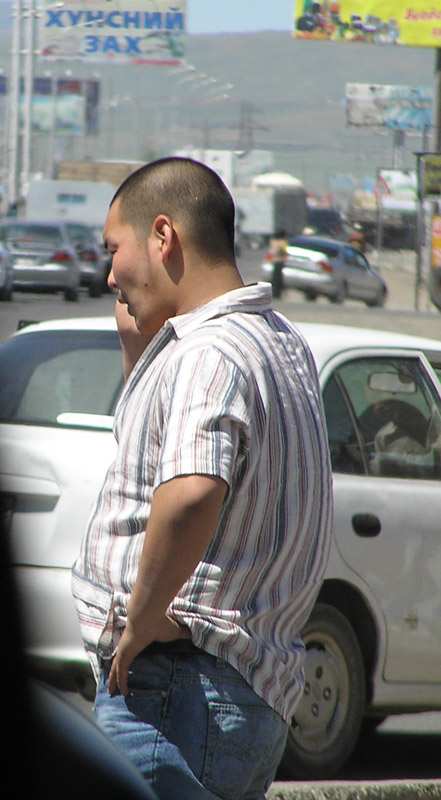
(Photo by me, Ulan Bator, June 2006 - the guy on the photo obviously has nothing to do with the article, except that he is a specimen of The Mongolian Man.)
Wong describes how the role of the Mongolian man is in a downward spiral. The case of Oynaa's family is one example of many. "The worst thing about Mongolian men is that they drink, are lazy and unfaithful. Then they bring sexually transmitted diseases back home. And he blamed the disease on me, even though I was toiling like crazy to take care of the child, our home and work at the same time", complains Oynaa, a divorced mother whom Wong interviewed in Ulan Bator. After the divorce, Oynaa's husband left her their child and kept their apartment for himself. But Oynaa went on to make a career and is now the manager of a fitness club, while her ex-husband lives off his parents.
"Oynaa blames the problems in Mongolia on the fact that the men are still mentally in the ger - the Mongolian felt tent [in SvD entertainingly enough misspelled as "sour milk tent"], where the warmest half is reserved for the men and the altar. The Mongolian ideal man is a carefree and indolent wrestler type who never takes initiatives or is in any hurry. He should sit there with his legs apart and with his hands on his knees. A woman, on the other hand, should be intelligent, hardworking, good at cooking and cleaning, beautiful, modest, quiet and submissive - all at the same time!"
In spite of this, women's influence in the higher levels of society has diminished considerably since "democracy" came along in 1990 - only 7 % of the Mongolian members of parliament are women today.
While this article could have been interesting as a more personal insight into the life of Oynaa's family and many more like them in Mongolia today, Wong goes on to draw simplified conclusions about Mongolian culture and history. "Macho ideals and hard men made it possible for the Mongolians to conquer a world empire under Genghis Khan. But it became a recipe for failure after the fall of the Soviet Union. The men gave up, got wasted and took out their frustration with their fists."
(So, nothing else really happened between Genghis Khan and 1990?)
Instead of drawing slightly orientalist conclusions about Genghis Khan, it should be easy to see the same pattern here as in Russia and many other post-Communist countries, where the transition has hit men harder - many of them drink and get violent in frustration, while a handful go on to rule the country. Women, on the other hand, keep on coping somehow, as they always have.
Certainly, there are exceptions to this bleak picture. And Wong writes about how in order to support men, the Mongolian Men's Association was founded. Since one year it has been obligatory for engaged couples to take at the very least a two-hour class at the Mongolian Men's Association before they are allowed to marry.
So, by and by, I guess maybe even Mongolian men will be able to show a "softer" side. They could start with changing the design of their saddles. The traditional Mongolian saddles are said to be made as uncomfortable as possible, so that the riders "stay hard", like "real men". My arse still hurts when I think about them.
(Photo by me, Ulan Bator, June 2006 - the guy on the photo obviously has nothing to do with the article, except that he is a specimen of The Mongolian Man.)
Saturday, 22 September 2007
National Geographic
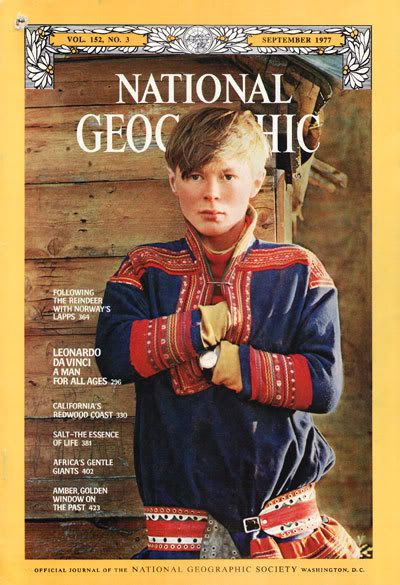
Once upon a time, I collected old National Geographics for my source library. For fun, I checked them for any Chirayliq material. Surely they - from 1963 to 1999 - would yield some treasures.
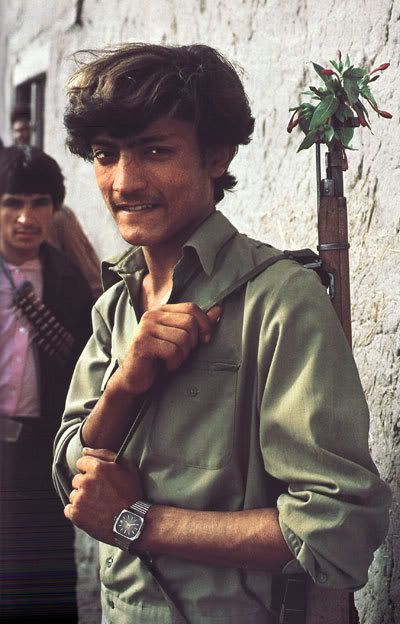
Of course, it wasn't so easy. Western ethnographers don't usually pay much attention to handsome men between 18 and 38, regardless what tribe or nation they might be photographing. The "normal" targets for National Geographic photoshoots are old, wizened grandpas, beautiful women, and children of both sexes. Thus, my chirayliq collection consists of two teenage boys, two men well into their middle age, and only a single one of our own age group.
The Sami boy at the top, Nils Johan Mienna (15 years old in 1977) represents the western edge of our dear Eurasian landmass. Reindeer herders inhabit the continent's rim all the way from Norway to East Siberia. I wonder if Nils wanted to continue his parents' traditions, or if he pursued other dreams. Typical of 1970's National Geographic, the article makes a big deal out of the demands of "modern" life and suggests that reindeer herding will be lost for the sake of efficiency.
From National Geographic's April issue, 1985, comes this portrait of an anonymous Afghani boy. He is described as a militiaman in a village near "Communist Kabul". The writer lets us know that the Marxist government conscripts 16-year-olds, and that the army is plagued by desertions. While Coca Cola continued to flow in the capital, the surrounding mujaheddin were dealing another kind of opium for the people. I wonder what happened to this young man.
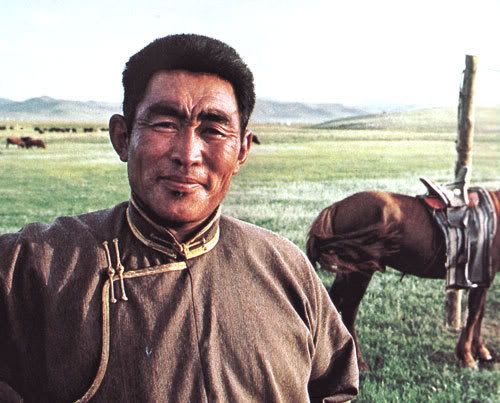
Towards the heart of the continent: A Kyrgyz herdsman reminds a French couple of his ancestor, Genghis Khan, on their way through the Wakhan corridor in 1972. It is not made clear if he is identical to their guide, Abdul Wakil, a man of few words and fewer smiles, but with unerring survival experience. Of course, the travellers respect Abdul, their life depends on him, but they also suggest that he doesn't understand how a jeep could be more valuable than 14 of his beloved camels.
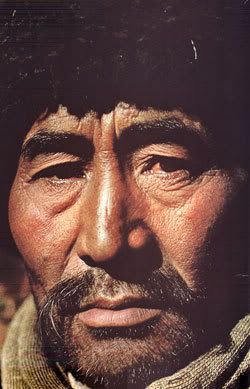
13 years later, another "descendant of the Khan" greets the National Geographic reporters with a Mona Lisa smile. Of course, the article is titled "Time Catches Up With Mongolia". There is nothing more reassuring for the Western reporters than the good old contrast between the backward but oh-so-authentic East, and the up-to-date but boringly normal West. Is modernization through sovietizised city slickers of Ulan Bator more wrong than Coca Cola in Kabul?
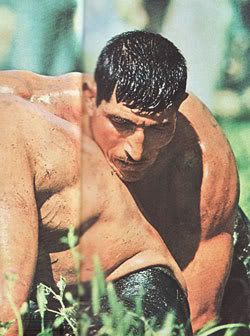
The final photo is from an article from 1968, "In the Footsteps of Alexander the Great". A Turkish oil wrestling contest takes place amid the ruins of Ephesus. Here, back in the Western end of Eurasia, Turks act out the roles of ancient Greeks and Macedonians in the imagination of the reporter.
Saturday, 12 May 2007
Chinggiz Khaan's Legacy
Чингис Хаан. Genghis Khan. Some still see him as the epitome of evil (common in Muslim historiography), some revere him as a founding father (the Mongols, naturally, and plenty of Central Asian peoples), and some exotize him as a mighty barbarian warlord, both horrifying and romantic (Europe and its Anglo-Saxon colonial offshoots).
As a historian, I prefer to leave the moral judgements aside (curiously the spelling manager marks both "exotize" and "judgements" as suspicious words). I'm merely interested in the images of the great Khan that are produced and reproduced in the world. For the purpose of this article, I will take a look on Central Asian men taking on the role as Genghis Khan, masquerading or mimicking a common image of him (we don't know what he really looked like!).

Reenactment in 2006, celebrating the 800th anniversary of Genghis Khan's establishment of the Mongol Empire.

Mobile communication is of vital importance for a nomad army!
To be continued on the same theme.
As a historian, I prefer to leave the moral judgements aside (curiously the spelling manager marks both "exotize" and "judgements" as suspicious words). I'm merely interested in the images of the great Khan that are produced and reproduced in the world. For the purpose of this article, I will take a look on Central Asian men taking on the role as Genghis Khan, masquerading or mimicking a common image of him (we don't know what he really looked like!).
Reenactment in 2006, celebrating the 800th anniversary of Genghis Khan's establishment of the Mongol Empire.
Mobile communication is of vital importance for a nomad army!
To be continued on the same theme.
Subscribe to:
Posts (Atom)