Friday, 9 November 2007

Prince of Tennis: Marat Safin

Every other post seems to be about a Tatar lately, but when I was researching Rustem Hayroudinoff before, I checked out the "List of Tatars" at Wikipedia, and realised that we haven't featured Marat Safin yet.


Marat Safin is a Russian Tatar born in Moscow. He held the "No. 1" world ranking for nine weeks in November and December of 2000, at twenty years of age. His parents are former tennis players and coaches, and his sister Dinara is also a professional tennis player. At age fourteen he moved to Spain to pursue tennis at a higher level than was possible in Russia at the time.
"He is known for his good looks, large physical size, athleticism, controversial antics, and aggressive 'power' style of play. He is fluent in Russian, English and Spanish", Wikipedia informs us.

He's not supercute, at least to me (his nose is much too small), but he's not too bad for a tennis player. ^_^


When Marat is angry, he likes to throw his racquet on the ground. Yes, I can understand that a sport like tennis can be frustrating.
He is quite famous for his emotional outbursts. Especially Fabrice Santoro is able to drive him crazy - according to Marat, "being told I would play Santoro was being told I was to die". Now now, Marat, it can't be that bad, can it? It's just a little ball made of rubber and felted fabric ...


Young Marat (left) at his first tournament, in Tashkent, wearing traditional garb ... which doesn't really go so well with tennis shoes and tennis socks:


The above photos are from Marat's official website. There are LOTS more over there.

Marat being tall (193 cm):


Of course, fanboys and fangirls have also spread less dressed images of Marat all over the Internet:


(Argh, in these photos he looks a bit like this cute French guy I met at a party and then lost, after stupidly not asking for any contact details and even forgetting his name. But the French guy's nose was bigger and he had more beautiful eyes.)

That's a barcode tattooed on Marat's shoulder, under the eye. I wonder what would happen if you'd try to scan him with one of those price checking devices they have in supermarkets ...


The bloggers who posted these pictures weren't at all interested in the two other guys, so I don't know who they are.

Thursday, 8 November 2007

Iosif Vissarionovich

Well, we already have a tag called "Stalin", and Stalin used to be quite the babe when he was young, so it was only a question of time until we would get to this. (We have a "Lenin" tag, too, but Lenin wasn't that attractive - he lost his hair very early and was generally rather asexual - as opposed to the womanizer Stalin, who kept the thick hair on his head until his death.)

Stalin in 1902, at age 24:


These are mug shots by the police in Batumi, where he was arrested for organising several large workers’ demonstrations.
(The first photo, according to Wikimedia commons, is from the book "Josef Wissarionowitsch Stalin - Kurze Lebensbeschreibung", Publishing for Russian literature in foreign languages, Moscow 1947", and the second was featured in E. Radziński's "Stalin. Pierwsza pełna biografia oparta na rewelacyjnych dokumentach z tajnych archiwów rosyjskich", Warszawa 1996.)


In 1919, at age 41, with comrades Lenin and Kalinin at the VIII Congress of the Communist Party of the Soviet Union, Stalin was still kind of good-looking. Or maybe this photo was retouched.

Unfortunately, Stalin suffered many abuses during his childhood and youth, was apparently just generally a bit of an a*****e, and ended up a grown-up with severe psychological problems, which turned out to be lethal for an immense number of people when he gained more and more power in the Soviet Union. (His story is quite typical for many politicians, though maybe a bit extreme.)

Those who in spite of everything would like to feel a bit of sympathy towards him might be interested in Vladimir Sorokin's novel "Blue Lard", where Stalin gets to show a soft spot in his mad love affair with a rather dominant Khruschev.

Tuesday, 6 November 2007

Rustem Hayroudinoff

Our avid reader Ilshat suggested another nice guy to be featured on Chirayliq, though his e-mail has been lying around in my mailbox for a very long time. Shame on me.

Rustem Hayroudinoff (aka Rustem Hayrutdinov, aka Röstäm Xäyretdin Äwzal ulı) is a Tatar and a world-famous classical pianist, born in Kazan into a family full of musicians.


He reminds a bit of a certain Tatar film maker acquaintance of mine.


(Second photo by Terence Donovan, collage used as a part of playbill cover for Rustem Hayroudinoff’s concert on October 18, 2007 at the Lütfi Kırdar Congress and Exhibition Center's Grand Hall, Istanbul, Turkey.)

Read more about Rustem and hear a short sample of his "Prelude in G Minor" by Rachmaninov.

Monday, 5 November 2007

Malen'kye Lyudi - Kazakhstan 2003

Malen'kye Lyudi by Nariman Turebayev (2003) is a movie about "little people", friends Bek and Max, who share an apartment in Almaty and just try to survive on odd jobs and daydreams. Bek (Erjan Bekmuratov) wants to find true love, Max (Oleg Kerimov) wants to move to Germany, where his grandmother lives.

«Max ist ein Frauenheld, Bek ein stiller Brüter, und den Moment, in dem sie ihre Liebe zueinander entdecken, nur um sich sofort wieder voneinander zurückzuziehen, inszeniert Turebayev grossartig.»
Frankfurter Allgemeine Zeitung


Another film from Kazakhstan distributed by Trigon Film in Europe is Killer / Marat, tueur à gages by Dareshan Omirbayev, 1999. Reluctant assassin Marat (incredibly handsome Talgat Assetov) is captured in the Mafia's net of extortion, lies and violence.

"Dareschan Omirbaew hat in drei Spielfilmen sein leidenschaftliches Temperament gezeigt und ein Kino von einer unleugbaren Poesie."
Thierry Jousse, Cahiers du Cinéma


Wednesday, 24 October 2007

Teuvo Tulio - Theodor Tugai

Extracts from my short biography at historia.ainurin.net:
- born Theodor Antonius Tugai in St Petersburg August 23, 1912, childhood in Latvia
- moved to Finland after his mother’s second marriage to a Finn; grew up in Helsinki
- became one of Finland’s most influential film directors and producers after an early career as silent film star
Read more...


In an impressive fur hat, and uniform


In uniform again; this looks more like the grey coat of the Finnish army


Valentinoesque profile


Tulio - levottoman veren antologia is an antholgy of Tulio scholarship and "poetic visions" inspired by his work, published by SKS. (A review in Helsingin Sanomat)

Sunday, 14 October 2007

Ola Wong on Mongolian men in Swedish daily Svenska Dagbladet

Ola Wong is a Chinese-Romanian guy born in Borås, Sweden, who works as a journalist and has also written a really interesting book about his grandparents ("No, I'm from Borås"). Today an article by him about Mongolian men was published in Swedish daily newspaper Svenska Dagbladet.

Wong describes how the role of the Mongolian man is in a downward spiral. The case of Oynaa's family is one example of many. "The worst thing about Mongolian men is that they drink, are lazy and unfaithful. Then they bring sexually transmitted diseases back home. And he blamed the disease on me, even though I was toiling like crazy to take care of the child, our home and work at the same time", complains Oynaa, a divorced mother whom Wong interviewed in Ulan Bator. After the divorce, Oynaa's husband left her their child and kept their apartment for himself. But Oynaa went on to make a career and is now the manager of a fitness club, while her ex-husband lives off his parents.

"Oynaa blames the problems in Mongolia on the fact that the men are still mentally in the ger - the Mongolian felt tent [in SvD entertainingly enough misspelled as "sour milk tent"], where the warmest half is reserved for the men and the altar. The Mongolian ideal man is a carefree and indolent wrestler type who never takes initiatives or is in any hurry. He should sit there with his legs apart and with his hands on his knees. A woman, on the other hand, should be intelligent, hardworking, good at cooking and cleaning, beautiful, modest, quiet and submissive - all at the same time!"

Wong writes about how 70 % of university students are women. He cites a common explanation for this - that people tend to think that "boys will be all right anyway", while girls are married off to another family, and their parents consider them to need an education to be able to stand on their own legs.
In spite of this, women's influence in the higher levels of society has diminished considerably since "democracy" came along in 1990 - only 7 % of the Mongolian members of parliament are women today.

While this article could have been interesting as a more personal insight into the life of Oynaa's family and many more like them in Mongolia today, Wong goes on to draw simplified conclusions about Mongolian culture and history. "Macho ideals and hard men made it possible for the Mongolians to conquer a world empire under Genghis Khan. But it became a recipe for failure after the fall of the Soviet Union. The men gave up, got wasted and took out their frustration with their fists."
(So, nothing else really happened between Genghis Khan and 1990?)

Instead of drawing slightly orientalist conclusions about Genghis Khan, it should be easy to see the same pattern here as in Russia and many other post-Communist countries, where the transition has hit men harder - many of them drink and get violent in frustration, while a handful go on to rule the country. Women, on the other hand, keep on coping somehow, as they always have.

Certainly, there are exceptions to this bleak picture. And Wong writes about how in order to support men, the Mongolian Men's Association was founded. Since one year it has been obligatory for engaged couples to take at the very least a two-hour class at the Mongolian Men's Association before they are allowed to marry.

So, by and by, I guess maybe even Mongolian men will be able to show a "softer" side. They could start with changing the design of their saddles. The traditional Mongolian saddles are said to be made as uncomfortable as possible, so that the riders "stay hard", like "real men". My arse still hurts when I think about them.

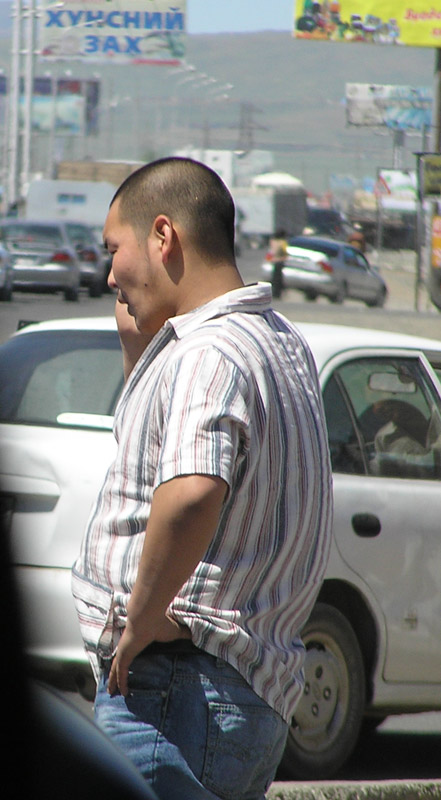
(Photo by me, Ulan Bator, June 2006 - the guy on the photo obviously has nothing to do with the article, except that he is a specimen of The Mongolian Man.)

Tuesday, 9 October 2007

Ulak-Tartysh part 2!

I don't know if the guys at englishrussia.com read Chirayliq, but they recently also had an entry about the great game of "grabbing the goat", with photos from various games. Here is a small selection (click for original size):


The guy in the purple shirt is my favourite:


There are many more pictures in the original post at englishrussia.com, but - as always with that blog - read the comments at your own risk ...
(Photos #2 and #3 are definitely from Kyrgyzstan, but the rest are only *probably* from the same country, as the sources don't cite their sources, so to speak.)